
By Norm Normand MBA
Canada is rebuilding its icebreaking fleet just as new logistics links are emerging between Nunavut and Greenland. The opportunity is to think beyond individual ships and ports toward a distributed Arctic mobility network.
On August 24, Canada committed $11.3 billion to six new Canadian Coast Guard program icebreakers to be built by Chantier Davie in Lévis, Quebec. This is an enormous investment, and an important one.
The new Polar Class 3 vessels will replace aging heavy and medium icebreakers, operate in Atlantic Canada and the St. Lawrence during winter, and deploy into the Arctic during the summer navigation season. Their missions will include icebreaking, search and rescue, environmental response, northern resupply, science and support to safe navigation. Construction is expected to begin in 2027, with the fleet entering service progressively into the 2030s. But there is another way of looking at an icebreaker that is particularly relevant to Canada’s North.
An icebreaker is mobile infrastructure
It does not merely travel along a transportation corridor. In many circumstances, it temporarily creates one. Where a conventional vessel encounters an impassable frozen waterway, the icebreaker changes the operating environment itself. A tanker, cargo vessel or community resupply ship can follow because another vehicle has made the route accessible.
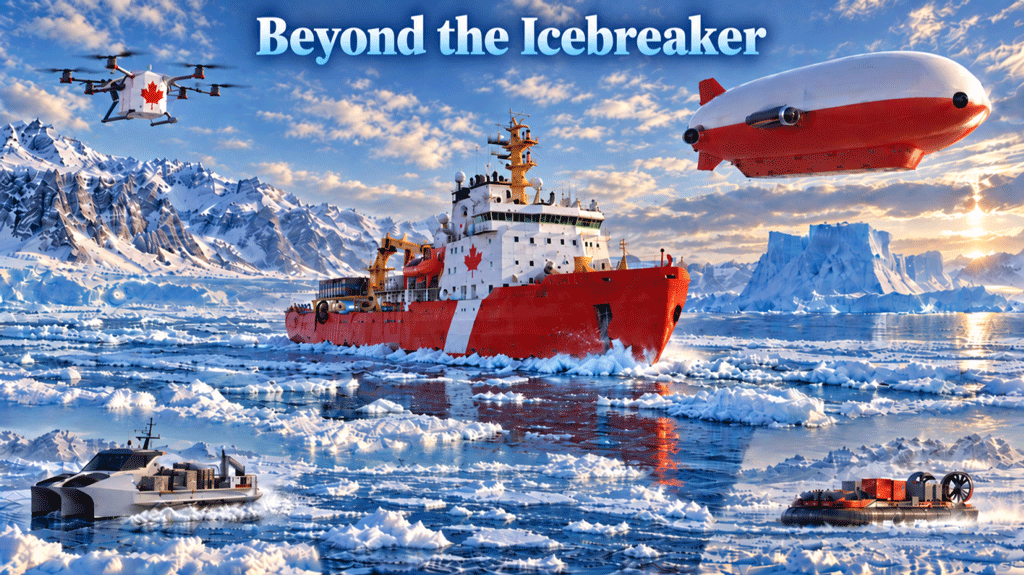
That principle extends well beyond icebreaking. An entirely new family of vehicles are finding a home within the Canadian Context. These vehicles can operate where the permanent infrastructure associated with conventional transportation either does not exist or would be prohibitively expensive to construct. I’ve been referring to these vehicles broadly as Low-Infrastructure Demand Vehicles, or LIDVs.
They can include cargo airships, Vertical Takeoff and Land (VTOL), remotely piloted aircraft, hovercraft, dynamic air-cushion vehicles, ground-effect vehicles and other autonomous surface systems. They are very different technologies, each finding their niche in different missions, but what connects them is not exactly how they move; it’s the minimal use of infrastructure that they need to move. This means that they do not require the construction of infrastructure to achieve their effect (e.g. the movement of cargo). That makes the Canadian Coast Guard (CCG) a uniquely positioned organization through which to consider their potential.
The Coast Guard’s mission is already becoming more distributed
The Coast Guard is changing. In May, the federal government announced $816 million over seven years to expand CCG maritime-security and surveillance capabilities. The investments include a year-round Maritime Domain Awareness Hub in Iqaluit, four new long-range Arctic marine radar sites, reconnaissance equipment for Coast Guard helicopters, and — significantly — the acquisition of short- and medium-range aerial, surface and subsurface drones capable of extending Coast Guard reach from land and sea. That last point is important. The conceptual leap from a ship-centric Coast Guard to a distributed system of crewed and uncrewed platforms has already begun. The question is how far that architecture could eventually extend.
From Power to the Edge to Infrastructure-Independent Operations
There are two related military concepts that help explain why this kind of distributed architecture matters. The first is Power to the Edge, or P2E. Developed in the early 2000s as a command-and-control concept, P2E argues that organizations become more agile when information, decision-making authority and the ability to act are pushed outward toward the people and systems encountering the problem. Rather than requiring every decision to travel up and down a hierarchy, well-informed elements at the “edge” can act within a commander’s intent and synchronize with one another. That makes sense in the Arctic, where distance, weather and communications can make centralized control difficult. However, pushing decision-making to the edge creates another problem:
The edge must also be able to see, communicate, move and sustain itself.
That is where the related idea of infrastructure-independent operations becomes useful and, in the military logistics context, what I refer to here as Infrastructure-Independent Warfare, or IIW.
IIW is not anti-infrastructure.
Quite the opposite. Ports, roads, airfields, communications networks and logistics hubs remain essential. The objective is not to eliminate infrastructure, but to reduce the degree to which operations depend upon any single piece of fixed infrastructure remaining available.
A force or, more broadly, a national response system, that can reach a location only through one harbor, one runway or one road has a critical single point of failure. A system with several ways to move information, people, supplies and equipment has freedom of action.
In that sense, IIW is better understood as infrastructure resilience through optionality. Fixed infrastructure provides capacity, efficiency and persistence. Low-infrastructure systems provide alternative pathways when geography, weather, damage, congestion or simple distance makes those fixed systems unavailable or insufficient.
LIDVs can provide some of those additional pathways. In military terms, P2E distributes decision-making, while IIW distributes access and sustainment. In practical Arctic terms, both point toward the same objective: giving dispersed organizations enough awareness, connectivity and mobility to act locally without being continuously tethered to a distant hub.
Importantly, none of this must begin during a conflict. Military planners have often used the term “Phase 0” for the routine shaping, presence and preparedness that occurs before a crisis. The Arctic is particularly well suited to that logic because many of the same capabilities needed in an emergency or conflict also deliver public value every day.
CCG surveillance, search and rescue, environmental monitoring, community resupply, scientific support and emergency response can build routes, relationships, operating knowledge and distributed support networks that create resilience long before they are needed under more demanding circumstances. The goal, therefore, is not infrastructure independence in the literal sense. It is freedom from dependence on any single piece of infrastructure.
Imagine a Coast Guard icebreaker operating not simply as a ship, but as one node in a much larger network.
Long-endurance RPAS could push surveillance hundreds of kilometers beyond the ship’s immediate sensor horizon. Persistent lighter-than-air platforms could potentially provide communications relay, maritime-domain awareness, ice reconnaissance or environmental monitoring over areas too large for conventional aircraft to remain continuously on station.
Smaller autonomous surface vehicles could operate closer to hazards than a crewed vessel reasonably should. Hovercraft and other amphibious low-infrastructure vehicles could bridge difficult transitions between ship, ice, beach and community; cargo-capable LIDVs could address an entirely different problem: moving people, equipment and supplies beyond the coastline. Reaching an Arctic shore is not the same thing as reaching the Arctic.
The last hundred kilometers may matter more than the first thousand
Canada’s enormous investments in ships solve an essential problem: maritime access. They do not eliminate geography.
An icebreaker may bring supplies through thousands of kilometers of difficult Arctic waters only to arrive at a place where there is limited port infrastructure, no connecting road, no suitable runway, or a destination another hundred kilometers inland. That is precisely where another transportation layer becomes useful.
Consider a heavy-lift cargo airship moving loads between a Coast Guard-supported coastal logistics node and an inland community, mine, radar installation or emergency site without waiting for a road to be constructed.
Or an RPAS launched from a Coast Guard vessel to locate a distressed vessel or missing person before a helicopter is committed.
Or a persistent platform maintaining communications over an emergency-response area while ships, aircraft and local responders operate below it.
Or a low-infrastructure surface vehicle moving equipment across the awkward interface between open water, broken ice, shoreline and tundra. The objective is not to replace the icebreaker.
It is to extend/multiply the icebreaker’s reach.
LIDVs become much easier to understand when they are presented not as competitors to Canada’s existing transportation systems, but as infrastructure multipliers for them.
Greenland makes this more than a theoretical discussion
Something else has happened almost simultaneously with Canada’s icebreaker investment.
On August 31, Sikuki Nuuk Harbour, operator of the Port of Nuuk in Greenland, signed a memorandum of understanding with the proponents of two major Nunavut port developments: Qikiqtaaluk AEDC’s proposed Qikiqtarjuaq Deep Sea Port and West Kitikmeot Resources Corporation’s Grays Bay Road and Port project. The agreement is explicitly intended to explore cooperation in maritime resilience, emergency response, vessel support, supply chains, infrastructure and environmental protection. Those words could almost serve as a list of candidate LIDV missions. The agreement is particularly interesting because it begins connecting established and prospective Arctic infrastructure rather than treating each project as an isolated endpoint.
Nuuk is an operating commercial Arctic port. Qikiqtarjuaq would provide a significant new deepwater node on the eastern side of Nunavut. Grays Bay, farther west, is being developed with the potential to connect the Northwest Passage to the North American highway network through an all-season road. The federal Major Projects Office is now involved with the project, and Canada committed up to $50 million this year for planning and preconstruction work. These are not yet pieces of one seamless transportation system. But increasingly, they can be thought about as nodes within one, and the Canadian Coast Guard is already operating across that wider geography.
This summer, for example, CCGS Jean Goodwill deployed north not only for Canadian icebreaking and search-and-rescue coverage, but also to support Operation Pacer Goose, the annual resupply of the U.S. Pituffik Space Base in Greenland. Nine Coast Guard icebreakers are scheduled to operate in Arctic waters during the 2026 season. The connections across Davis Strait are therefore not something we need to invent; they already exist. What we should be asking is how to make them denser, more resilient and more useful.
From individual assets to an Arctic logistics system
This is where I believe Canada needs to change the level at which it thinks about Arctic transportation. We (the Federal Government) tend to procure things. An icebreaker. A port. A road. A radar. An aircraft etc. Each can be entirely justified on its own merits. But the strategic value of each grows substantially when it is designed from the beginning to interact with others.
Seen through the lens of P2E and IIW, the objective is therefore not simply to distribute platforms. It is to distribute options: more places from which Canada can sense, decide, move and sustain activity. A $11.3-billion icebreaker fleet becomes more valuable if its operational reach can be extended by inexpensive uncrewed systems. A deepwater port becomes more valuable if cargo arriving there can move to places without roads. A maritime-domain awareness hub becomes more useful when multiple kinds of persistent sensors feed information into it. An emergency-response network becomes more resilient when no single runway, harbor or road determines whether assistance can reach the scene. This is the real promise of low-infrastructure transportation. It is not a replacement transportation system.
It is a mobility layer connecting the systems we already have and allowing them to reach places they otherwise cannot.
The Coast Guard may be the ideal proving ground
There is another advantage to looking at LIDVs through a Coast Guard lens. The use case is not exclusively military. Search and rescue is not exclusively military. Environmental monitoring is not exclusively military. Ice reconnaissance, community resupply, scientific support, pollution response, navigational support and emergency communications are not exclusively military. Yet almost all of them contribute to Canadian presence, resilience and sovereignty. That creates an unusually wide spectrum of missions in which emerging technology can prove itself while delivering tangible public value. This is not to suggest that the Coast Guard necessarily needs to own every platform. Some capabilities could eventually be purchased as services: persistent surveillance hours, logistics lift, environmental monitoring, communications coverage or remote sensor support.
This would allow emerging systems to demonstrate operational utility before Canada commits to large fleets of immature technologies. The Coast Guard’s current acquisition of aerial, surface and subsurface drones suggests that the basic concept, extending a crewed platform through distributed uncrewed systems, is already becoming institutional reality.
LIDVs simply take that idea farther.
That may be the most important connection to IIW and P2E. Capabilities used routinely in peacetime do more than demonstrate technology. They establish the operating patterns, local relationships, communications pathways and logistics networks that allow a distributed system to function before circumstances become urgent.
Fit the network now. Choose the vehicles later.
Canada will not receive all six new program icebreakers tomorrow. The complete fleet is expected to take well into the next decade. The Qikiqtarjuaq and Grays Bay projects will also take time. That is precisely why the design choices being made now matter.
The important near-term question is not whether the Coast Guard should purchase a particular cargo airship, hovercraft or autonomous vehicle next year. It is whether the ships, ports, surveillance architecture and northern logistics systems Canada is designing today will be able to accept useful technologies when they are ready.
Naval procurement has a useful expression for this: “fitted for but not with.” The capability does not have to be installed today; the platform simply avoids design choices that make adding it tomorrow unnecessarily difficult or expensive. Applied to Arctic logistics, that suggests five practical, technology-neutral design decisions Canada can make now.
- Reserve growth margin before it is needed
On the ships, that means preserving reasonable margins in space, weight, electrical power, cooling, network capacity and deck access for future mission systems. It also means thinking in terms of modular mission spaces, containerized equipment and mounting points rather than assuming every future sensor or uncrewed system will require a bespoke retrofit. Ashore, the equivalent is reserving land, utility capacity and staging space around Arctic ports before every available square meter is committed to today’s requirements. A small allowance in the original design can avoid a very expensive modification later.
- Make the digital interfaces open, secure and vendor-neutral
The Coast Guard is already investing in a year-round Maritime Domain Awareness Hub in Iqaluit, new radar sites and aerial, surface and subsurface drones. Future LIDVs should be able to contribute to that picture without forcing Canada to rebuild the network around each new platform. Ships and shore facilities should therefore be designed around secure, documented data interfaces, common time and position standards, network segmentation and the ability to ingest third-party sensor feeds. The principle is simple: Canada should own the architecture even when it does not own every vehicle connected to it.
- Design launch, recovery and handling around classes of vehicles — not individual products
No one can say with confidence which uncrewed aircraft, surface vehicle, lighter-than-air platform or amphibious system will prove most useful a decade from now. Canada does not need to guess. Icebreakers can instead preserve flexible deck zones, lifting and tie-down points, crane access, sheltered maintenance space, charging connections and locations for containerized control stations. Ports can do the same with adaptable ramps, pads, cargo-handling areas and maintenance facilities. The aim is not to pre-select an OEM. It is to make future competition possible.
- Build Arctic ports as transfer nodes, not endpoints
A deepwater port solves the problem of getting a ship to shore. It does not necessarily solve the problem of moving people, equipment or cargo from the shoreline to the actual destination. Qikiqtarjuaq, Grays Bay and future northern ports should therefore preserve space and access for onward movement by multiple modes: conventional road vehicles where roads exist, but also aircraft, RPAS, amphibious systems and future low-infrastructure cargo vehicles where they do not. Clear staging areas, unobstructed operating approaches, heavy-lift handling capacity and adaptable shore access can turn a port from a terminus into a true logistics node.
- Make Canada–Greenland interoperability a design requirement
The emerging cooperation between Nuuk, Qikiqtarjuaq and Grays Bay creates an opportunity to standardize more than relationships. Canada and Greenland could use that cooperation to develop compatible procedures for data sharing, emergency response, cargo handling, temporary basing, charging and servicing of uncrewed systems, and mutual support during Arctic operations. The objective would not be a single vehicle or supplier. It would be an Arctic logistics network in which a capability proven at one node can be supported at another across Davis Strait.
Fit the interfaces now; compete the vehicles later.
That approach would also give Canada a better way to manage technological risk. Instead of betting early on a particular platform, government can define the interfaces and operational effects it needs, invite multiple technologies to demonstrate against them, and initially buy useful capability as a service where appropriate. The infrastructure remains government-controlled; the technology can continue to evolve.
“Fitted for but not with” is therefore more than a shipbuilding phrase. It is a practical policy for an Arctic in which the transportation technology of the 2030s will not look exactly like the transportation technology of 2026. The key is to ensure that the infrastructure Canada is paying for today does not accidentally lock those future options out. Canada is investing billions in the heavy infrastructure and heavy ships necessary to sustain presence in the North. Nunavut and Greenland are simultaneously beginning to connect their maritime infrastructure into a more cooperative Arctic network. The Coast Guard is acquiring distributed sensors and uncrewed systems to see farther from its ships and shores.
In P2E terms, that pushes awareness and capacity toward the edge. In IIW terms, it gives that edge more than one way to remain connected and supplied. Those developments should not be viewed separately. They point toward the beginnings of something much more interesting:
A distributed Arctic logistics system in which fixed infrastructure, ships and low-infrastructure vehicles reinforce one another.
The new icebreakers will open the water. The next question is how far beyond the red hull Canada wants that access to reach.
