The Royal Danish Navy’s mine countermeasures capability and Diving Service have returned home after more than two months deployed with NATO’s Standing Mine Countermeasures Group 1 (SNMCMG1). The Danish capabilities were embarked on a Canadian warship. At the same time, Danish Canadian cooperation on mine countermeasures contributes to both nations’ ability to operate in the Arctic.
Danish mine countermeasures specialists from MCM Denmark and divers from the Royal Danish Navy Diving Service have returned to Denmark after more than two months deployed with NATO’s Standing Mine Countermeasures Group 1 (SNMCMG1).
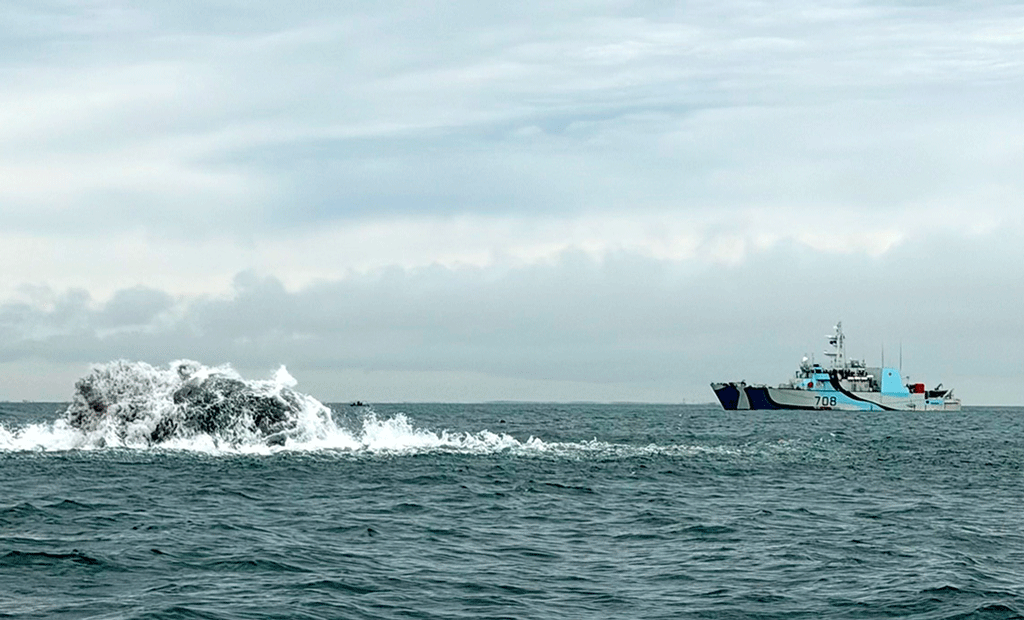
During the deployment, the Danish personnel and equipment were embarked on the Canadian warship HMCS Moncton.
“It is a cooperation that is highly beneficial to both countries. The Canadians provide the ships, while we contribute sensors and diving capabilities. Neither of our capabilities would be able to fulfil a role in the mine countermeasures group on its own, but we complement each other and operate as an integrated capability from two nations,” says Kristian Lyhne-Nielsen, who led the Danish team in the mine countermeasures group.
The cooperation has also been welcomed on the Canadian side.
“The Danes have increased our operational capability through their equipment and expertise. Without them, we would not have been able to carry out the tasks assigned to the group. We have worked well together, and by sharing knowledge and procedures, we have developed our standards and ways of conducting operations,” says Lieutenant-Commander Justin Wung. He is the Commanding Officer of HMCS Moncton and, at the same time, commander of the Canadian force leading SNMCMG1.
Supporting seabed mapping in Danish waters
During the period of Danish participation, SNMCMG1 took part in Exercise Northern Viking in the North Atlantic, focusing on the defense of Iceland and the sea lines of communication in the North Atlantic and the strategic GIUK Gap (Greenland-Iceland-United Kingdom).
The task group also took part in an exercise while transiting Danish waters. This gave the mine countermeasures vessels an opportunity to train on historic mines. The exercise allowed the many specialist capabilities involved in a mine countermeasures operation to train together across the chain of activities that would be followed during a real-world mine clearance operation.
As an additional benefit to Denmark, all the mine countermeasures vessels provided the data they collected during the exercise to the new Danish center under the Royal Danish Navy Command, which works with underwater data and seabed mapping.
“This means that we gain a better overview of the Danish seabed. We do not need to examine the objects that have been found and identified again. Conversely, when we return and find something that was not there previously, we can focus our efforts on analyzing it,” continues Kristian Lyhne-Nielsen, who in his day-to-day role heads the Royal Danish Navy Centre for Data Analysis.
A bridgehead for stronger Danish Canadian cooperation
This is the second time that the contribution from MCM Denmark and the Royal Danish Navy Diving Service has been deployed with the Standing Mine Countermeasures Group aboard a Canadian ship. However, according to the head of the part of the Royal Danish Navy responsible for activities below the surface, this is only the beginning of even closer cooperation between the two nations – not least in the Arctic, where both Denmark and Canada have strategic interests.
“I see this as a bridgehead for increased cooperation between Denmark and Canada. Both nations have the capabilities to carry out tasks in the Arctic, but we are stronger together, and we can complement each other. We have now had Danish containers embarked on Canadian ships in Danish and European waters. Next time, we may want to try doing the same in Arctic conditions,” says Commodore Bo Snestrup, Head of the Subsurface and Seabed Warfare Division in the Royal Danish Navy Command.
The Royal Danish Navy plans for future Danish contributions to SNMCMG1 to also be conducted in cooperation with Canada.
