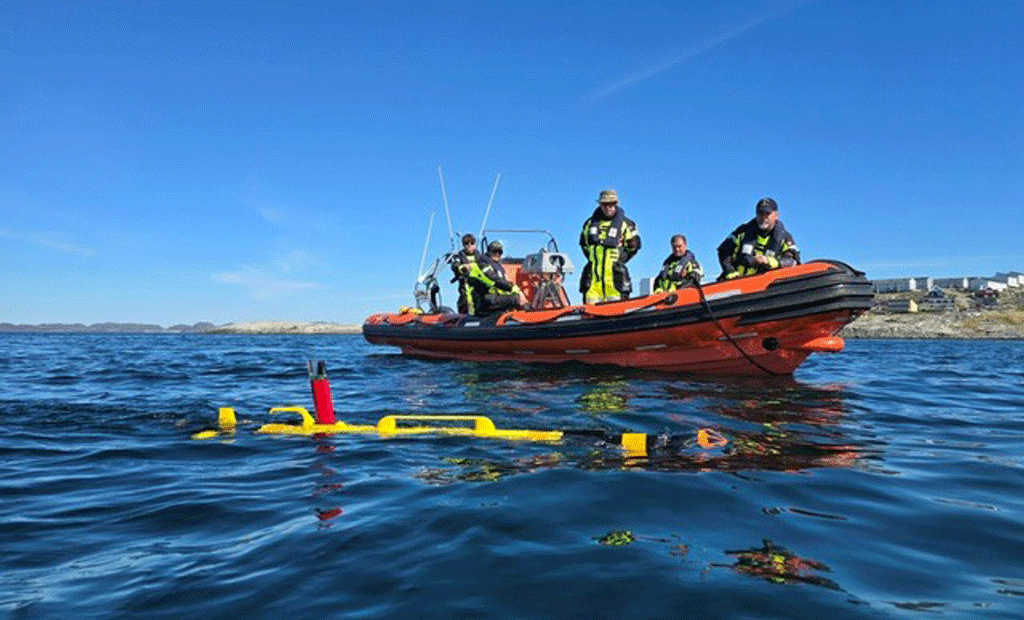
In the icy blue sea outside Nuuk, personnel from the Royal Danish Navy have recently had their eyes fixed on the seabed. Here, they have evaluated their underwater drones together with Canadian colleagues.
Normally, the underwater drones work in domestic Danish waters, where the seabed and water temperature are significantly different than in Greenland. Therefore, Jan Stripp, who is the commander of the Navy’s Subsurface & Seabed Warfare division, has gone to Greenland with his team.
“We want to challenge ourselves and the drones in Greenland, where both drones and we are out of our comfort zone. Now we will evaluate what we can do with the drones in the cold, deep water in Greenland,” says Jan Stripp, who is head of the Navy’s Subsurface & Seabed Warfare Division.
The Navy’s Subsurface & Seabed Warfare Division is assessing the underwater drones as part of the increased support to Greenland in connection with Arctic Endurance in cooperation with the Arctic Command.
“We need to get better at using the drones but also find their limitations in other waters. We have diverse types of drones, and we need to find out which one works best in the cold and clear seas around Greenland. It is a completely different task in Greenlandic waters than at home,” says Jan Stripp.
Important cooperation with Canada
The test and exercise in Greenland will take place in collaboration with Canada. Joint training between the divers and the drone operators has taken place for many years to strengthen the collaboration.
“We get a lot out of this collaboration because our setup is mobile. We must be able to move out and work on different platforms, such as ships, so that we train to get out and work under realistic conditions,” says Jan Stripp. “The Canadians also have some other drones and workflows. So, we can learn a lot from each other.”
Last year, the joint training took place together with NATO’s standing mine clearance force SNMCMG1, where Canada sent two ships, and Denmark contributed with sensor teams (divers and drones).
“The collaboration is extremely important, where they can deliver ships and platforms – and thus increase our ability to move out. We work from a tool-box system, where we possess different tools that can be deployed on different platforms (ships),” says Jan Stripp. “We are working to become more and more mobile, so we can move out and be used everywhere.”
At the current test in Greenland, Canada is contributing with two observers who follow the Danes and learn from Danish knowledge.
“The ability to observe these trials gives the Canadian Navy insight into the capabilities of allied technology operating in Arctic waters. By combining our expertise with that of the Danish Navy, we strengthen our joint ability to monitor the seabed and protect critical infrastructure across the northern regions,” says Commander Greg Richards, Canadian Mine Warfare Officer at Atlantic Fleet. “Equally important is that the collaboration with our Danish partners strengthens our interoperability and deepens our common understanding of the special challenges associated with operations in an Arctic environment.”
Critical infrastructure
An important part of the exercise and training in the Arctic is also about the Navy getting a picture of what is going on below the sea surface throughout the Kingdom.
Protection of critical infrastructure is crucial for the security and cohesion of the Danish Realm, which is why many different authorities participate in the monitoring and protection of the infrastructure.
