
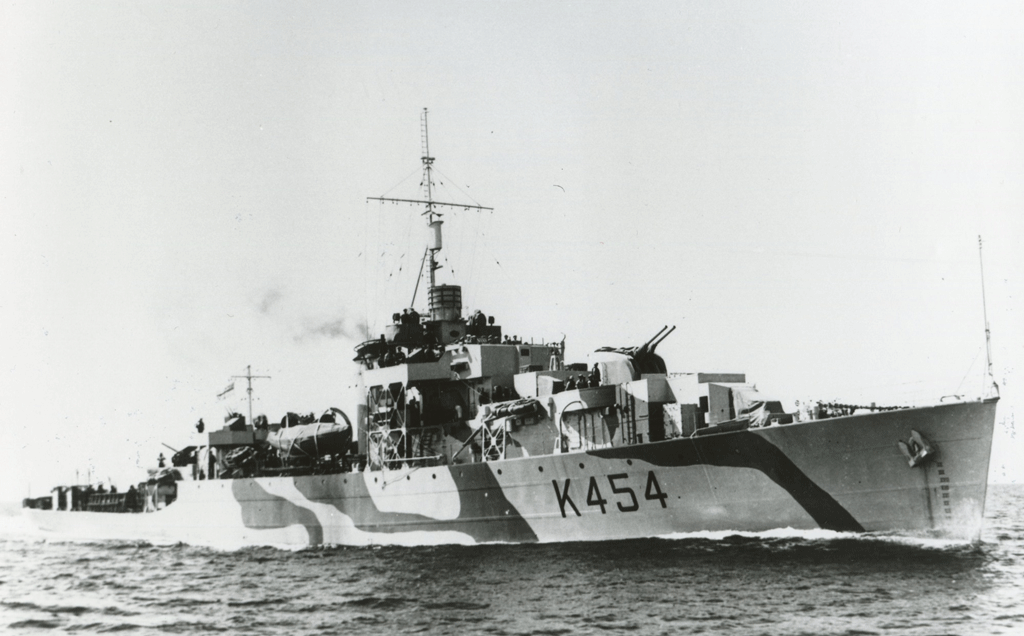
Commissioned on 28 Jul 1944, at Esquimalt, St. Stephen arrived at Halifax on 28 Sep 1944 and in Oct 1944 proceeded to Bermuda to work up. Returning in mid-Nov 1944, she joined EG C-5 and spent the balance of the war as a mid-ocean escort. She left Barry, Wales, on 27 May 1945, to take passage home with convoy ON.305, and early in Jun 1945 began tropicalization refit at Dartmouth, N.S. This was cancelled in Aug 1945 and on 30 Jan 1946, the ship was paid off at Halifax and laid up in Bedford Basic. On 27 Sep 1947, she was re-commissioned, having undergone alterations to fit her as a weather ship. She spent the next three years at weather station 4YB (Station “Baker”) between Labrador and Greenland, on rotation with an American ship
until Aug 1950, when she sailed to Esquimalt to be paid off on 31 Aug 1950 and lent to the Department of Transport. Retained primarily as a “spare” in the event of a mishap to St. Catharines or Stone Town. She was purchased by the Department in 1958. Ten years later she was sold to a Vancouver buyer, purportedly for conversion to a fish factory ship.
The following is an excerpt from the Canadian Coast Guard web site:
“It was to this class, rapidly becoming redundant in the post war navy, that the Department turned as the basis of an entirely new kind of vessel, the specially equipped deep sea weather ship. The first of the line, HMCS St. Stephen, remained for a while as a weather ship under naval control. With a complement of some ninety officers and ships company, and a civilian staff of five Transport meteorological observers, HMCS St. Stephen served in the North Atlantic, on alternate patrols with a United States ship on station “Baker”, from Dec 1947 till Jun 1950 by which time, for economic reasons, it was decided that Canada should abandon her half share in the Atlantic work and take full responsibility for station “Peter” in the Pacific, in position 50 deg. North latitude and 145 deg. West longitude. This position is 900 miles from Vancouver.”
“The St. Stephen, which had been used as a standby vessel to support the others, was converted in the same way by 1955 but, as they were able to keep going without replacement, her services were never needed, and she remained in reserve at Victoria. If rumor is to be believed, this was just as well for a cannibal diet of fittings and equipment had sustained life in her sisters at many an awkward moment.”
Weather ship ST STEPHEN: Did you know that when ST STEPHEN went to sea, she always has a list? The reason was they converted one of the water tanks to a fuel tank so she would have extra fuel to be able to stay on station for 30 days. Did you know that ST STEPHEN was fitted with a mast and a sail? The frigate was fitted with a special mast and sail for use in heavy weather for better maneuverability and fuel consumption. ST STEPHEN trivia courtesy of Gerry Cunningham, RCN
