
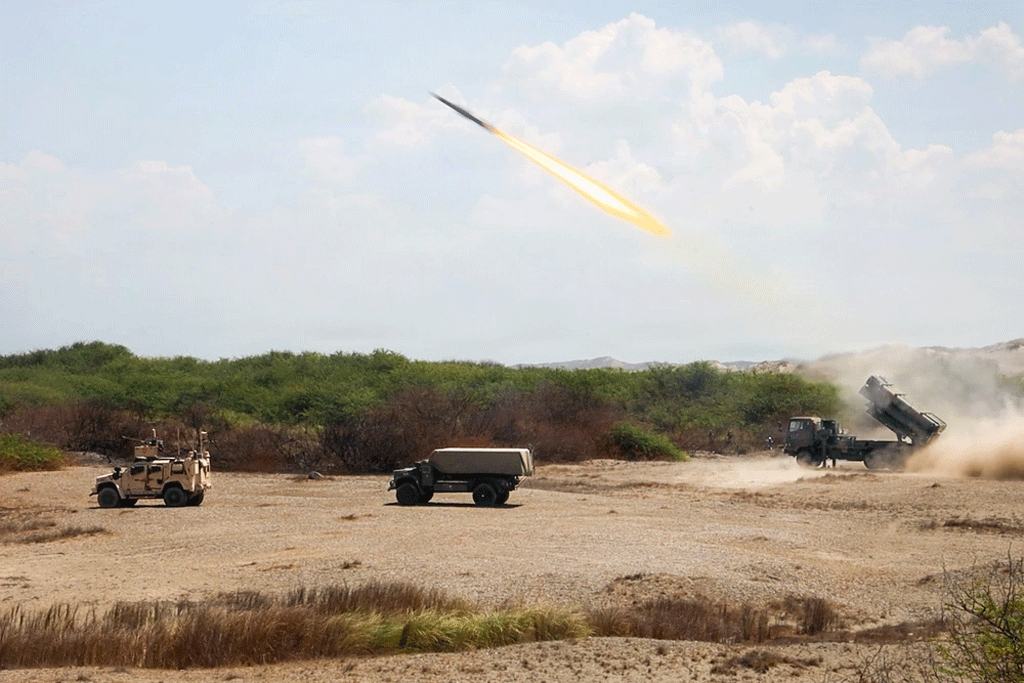
Philippine, U.S., Japanese, and Canadian forces integrated land, sea and air platforms to sense, strike and destroy two decommissioned ships off the western coast of Northern Luzon during Balikatan 2026, May 6-7.
Throughout the two-day Joint Task Force Maritime Strike, combined forces tested and validated their ability to coordinate communication systems, decisions, and advanced capabilities to accomplish a shared tactical mission. As the culminating live-fire training event of the exercise, the MARSTRIKE showcases the combat credibility of the 75-year-old U.S.-Philippines Alliance, reinforced by partners and allies.
“The MARSTRIKE demonstrated the strength of our combined and joint force by integrating sensors and shooters across multiple domains to achieve a shared tactical objective,” said U.S. Marine Corps Maj. Gen. Thomas Savage, commanding general of the U.S. joint task force – forward. “This event proved that the Armed Forces of the Philippines, the U.S. joint force, and the Japan Self-Defense Force can deliver long-range fires on a maritime target as one capable, ready, and lethal team.”
On the first day, the combined force struck the Philippine Navy BRP Quezon (PS-70), a decommissioned vessel that served as the target, with a Japan Ground Self Defense Force Type-88 Surface-to-Ship Missile while U.S. Army High Mobility Artillery Rocket Systems also delivered on-target strikes.
“Deploying the Type-88 Surface-to-Ship Missile in this complex MARSTRIKE allowed us to validate our tactical integration with U.S. and Philippine forces,” said JGSDF Lt. Col. Ishikawa Daisuke, public affairs officer with the joint staff office. “Sequencing our capabilities proves that our defense systems can operate seamlessly together which is essential for defense of the maritime domain.”
On the second day, Philippine Air Force FA-50PH Fighting Eagles and A-29 Super Tucanos engaged with and sank the BRP Rajah Sulayman (PS-20), a second decommissioned Philippine Navy vessel.
Other assets from across the multilateral force provided sensors, command and control, and simulated fires. This included U.S. assets like the U.S. Marine Corps’ Navy-Marine Expeditionary Ship Interdiction System and Marine Air-Defense Integrated System; fixed-wing aircraft from the U.S. Navy, U.S. Air Force, Philippine Navy, and JGSDF; unmanned aerial vehicles from the U.S. Navy and Air Force; and the HMCS Charlottetown with the Royal Canadian Navy.
“Earlier today, our team participated in a MARSTRIKE evolution with our American and Philippine counterparts,” said Royal Canadian Navy Cmdr. Jonathan Maurice, commanding officer of HMCS Charlottetown. “The event provided a valuable opportunity to strengthen coordination, fine-tune communications, and enhance our joint readiness.”
The MARSTRIKE, and other military training events conducted during Balikatan 2026, builds compatible capabilities, enhances combined force coordination, and exemplifies the unwavering “shoulder-to-shoulder” spirit of the alliance.
“The successful execution of the Maritime Strike activity demonstrates the growing level of interoperability between the Armed Forces of the Philippines and our allies,” said Philippine Marine Corps Col. Dennis Hernandez, AFP spokesperson for Balikatan 2026. “Through coordinated planning, information-sharing, and precision engagement, we were able to effectively integrate maritime, air, and ground capabilities in a complex operational environment.”
