By Adam Coombs
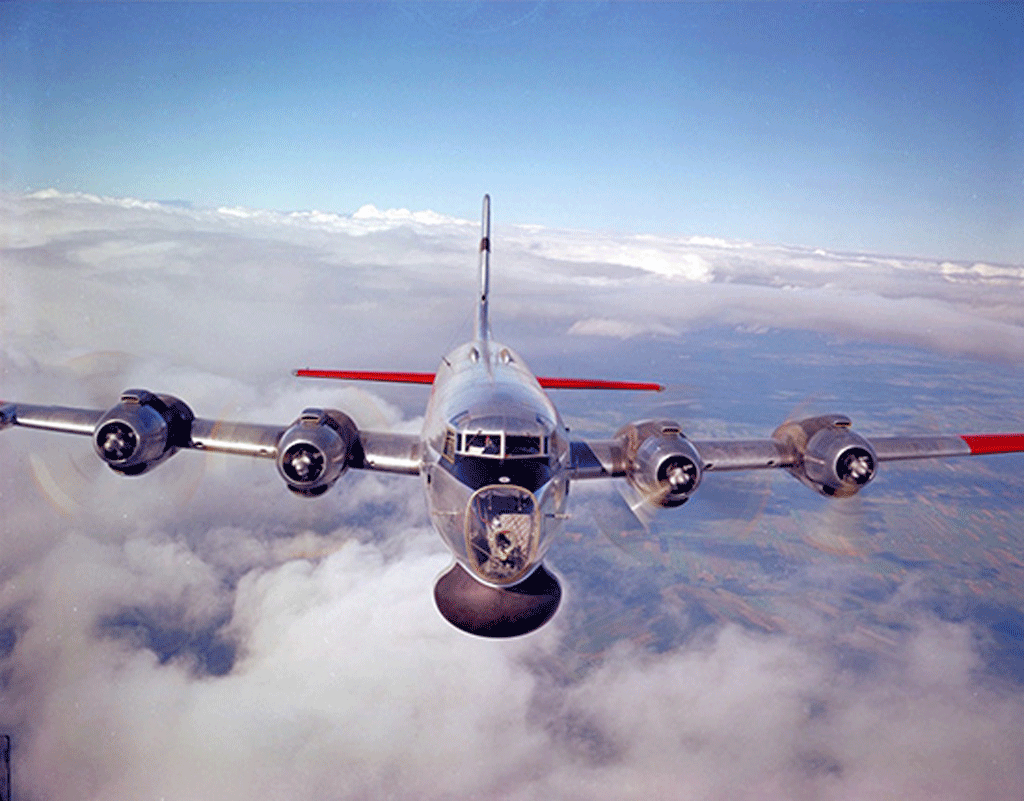
On 1 and 2 October 1959 a CP 107 Argus of the Royal Canadian Air Force (RCAF)’s 407 Maritime Patrol Squadron set the Canadian military record for the longest flight without refueling, flying 7,350km from Royal New Zealand Air Force Base Ohakea, north of Wellington, New Zealand, to RCAF Station North Bay. The flight took 31 hours, a record that remains (unofficially) unbroken to this day Normal Argus flights were not so lengthy, but a typical patrol over the North Atlantic hunting for Soviet submarines lasted 18 hours. Often, the ground crew that helped the Argus take off one morning would bring the plane into the hangar the next day. These incredible feats of airborne endurance were only possible due to the combined dedication and training of the RCAF personnel and the technological accomplishment that was the CP 107 Argus.
The Argus, which entered service in 1957, was one of the most effective anti-submarine warfare (ASW) platforms operated by members of the North Atlantic Treaty Organization (NATO) throughout the 1960s.The aircraft, named after the hundred-eyed watchman from Greek mythology, is also a Canadian version of another mythological creature: a unicorn. The plane was a rare domestically designed and manufactured military aircraft that delivered on its promised functionality and provided more than two decades of effective service. Yet, throughout the procurement process the Argus faced numerous obstacles, including substantial opposition from the Royal Canadian Navy (RCN). Even once initial production had been approved by the Canadian government, cost overruns threatened to ground the project and limit it to a production run of four to six aircraft. Ultimately, 33 of an initially proposed 50 CP 107 aircraft were manufactured and served the RCAF and later the unified Canadian Forces from 1959 until 1981.
In the years since the Argus procurement process, acquiring aircraft for the RCAF continues to make news headlines. Maritime patrol aircraft even received their moment in the ‘procurement controversy’ spotlight in 2023. At that time the Canadian Government, led by Prime Minister Justin Trudeau, announced the purchase of up to 16 Boeing P-8 Poseidon aircraft for the RCAF to replace the 40-year-old CP 140 Aurora. This choice was controversial as Canadian company Bombardier Aviation alleged they could manufacture a domestic alternative but were never given an opportunity by the government to demonstrate their offering. At the root of this dispute was a question as to whether to support Canada’s domestic aviation industry by selecting an unproven new aircraft or to purchase an ‘off the shelf’ American option already operated by other NATO allies.
In this modern case, Canada selected a proven aircraft that could be delivered by Boeing in the timeline required. Yet, facing a very similar decision in the early 1950s with an aging fleet of Lancaster aircraft needing replacement, and both American and British options available for purchase, the Canadian Government of Louis St. Laurent made a different choice. Overcoming opposition from the RCN, the RCAF convinced successive governments to invest in the CP 107 Argus, a Canadian designed and manufactured option. How and why the RCAF made the decision to procure a domestically produced maritime patrol aircraft and then convinced Canadian Governments to support this decision is the focus of this paper.
To understand the history of maritime aviation in Canada after the Second World War readers should picture a duck. These birds are neither exclusively inhabitants of the air nor of the water, rather existing in two domains at once. Similarly, the historiography of maritime air is part air-power history and part naval history, existing in two worlds but rarely at the centre of either. This division in writing between naval and aviation history has led to the story of the Argus and its lessons for modern procurement getting lost in the space between the two fields.
Broader histories of the RCAF in the Cold War and beyond contain brief mentions of maritime air, usually a narrative summary of the aircraft flown by Maritime Air Command. Even within otherwise excellent academic histories of the RCAF, maritime air is often treated separately from the rest of the force, its history consigned to one section of a broader text. Within Canadian naval history, historians focused on how Canada responded to the strategic challenge of defending Canada’s oceans have done a good job at situating the role of aircraft, both shore-based maritime aviation and carrier-based naval aviation, within the broader planning of Canadian and NATO forces tasked with seaward defense. Works by Isabel Campbell, Norman Friedman, Sean Maloney and Michael Whitby all detail the importance of aerial assets in Canadian, Commonwealth and NATO ASW efforts during the 1950s and 1960s. However, these works focus on the naval side of the equation, treating maritime patrol aircraft as deployable assets that figured into naval planning.
When it comes to procurement, naval historians have examined the planning and purchasing process for key assets such as aircraft carriers, destroyers and ship-borne helicopters. Fixed-wing aircraft procurement for the RCAF remains exclusively the purview of air force historians However, these air power scholars have focused on fighter jet procurement during the Cold War, mostly to the exclusion of other aircraft. Recent work by Richard Mayne has centered maritime air but he examines the role of the CP 140 Aurora and its incorporation into modern Canadian Armed Forces operations, not the earlier generation of patrol aircraft like the Argus. Additionally, the fact that the Argus development programme happened simultaneously with that of the Avro Arrow means that attention is distracted by this high-profile failure. There is, after all, a Canadian Heritage Minute about the Avro Arrow, but not for the Argus.
The few writers who discuss the decision to purchase the Argus all point to the key role of Air Marshal (A/M) Wilfred A. Curtis, Chief of the Air Staff from 1947 until January 1953. It was during this period that the RCAF established Maritime Air Command, acquired the modified Lancaster MR3 aircraft, commissioned a prototype aircraft based on the Bristol 175 Britannia that would ultimately become the CP 107 Argus, and convinced the Canadian government to purchase the Lockheed P2V7 Neptunes as a stop gap measure. Certainly, Curtis’s influence was a significant factor in getting the Argus from the drawing board to the runway, but he was only one member of a unified RCAF leadership that all lined up behind a purchasing plan for maritime patrol aircraft including Neptune and Argus airframes. Even after Curtis’s retirement, other key figures such as Air Vice-Marshal Frank Miller, Vice-Chief of the Air Staff, and Air Marshal C.R. Slemon, Curtis’s eventual replacement, all continued to back the Argus programme. Their role in the process is also critical to understanding the entire story, but it has been given little attention. Similarly, the inter-service disputes between the RCAF and the RCN over the direction and control of maritime air in Canada remains unanalyzed in the existing historiography. This paper will pick up both analytical threads.
Beginning in 1950, the RCAF articulated a clear need for a long-range land-based maritime patrol aircraft for the seaward defense of Canada. After struggling to acquire planes with sufficient endurance to cover the entirety of the Atlantic Ocean – known as the Mid-Atlantic Gap – during the Second World War, the RCAF senior leadership wanted to ensure that the RCAF’s new maritime patrol aircraft would have sufficient range to patrol beyond Canadian waters. As a result, the RCAF Air Staff were determined to procure long-range patrol aircraft in sufficient numbers to meet NATO force goals and provide aircraft to patrol the entire North Atlantic Ocean.
After limited internal debate, the RCAF senior leadership unanimously agreed to acquire 25 American-manufactured Lockheed P2V7 Neptune medium-range planes to cover the immediate need for operational aircraft. They also supported the design and construction of a domestic patrol aircraft by Canadair, which was eventually named the CP 107 Argus and was based on the British Bristol 175 Britannia, a civilian airframe. The RCN was against the financial outlay this plan required but was unable to present a compelling alternative to the Chiefs of Staff Committee and the Government of Louis St. Laurent. Although some Navy officers such as Commander A.B.F. Fraser-Harris, Director of Naval Aviation, opposed the Argus programme, the RCN did not present a unified opposition, instead accepting other concessions from the government in exchange for dropping objections to the RCAF’s Neptune and Argus procurement plan. Overall, this paper will argue that the ability of the RCAF’s united leadership to persistently present a clear ASW vision allowed them to successfully secure the Argus for their force in the face of disunited opposition from the RCN.
The Need for Maritime Air
In the immediate aftermath of the Second World War, the RCAF, along with the other branches of the Canadian military, faced significant cutbacks. The Liberal Government of Mackenzie King had introduced an ambitious program of public spending on the nascent Canadian welfare state and saw cuts to the military budget as a means of finding the necessary funds. In response to the reduced budget allocations, in April 1946 the RCAF presented “Plan B: Post-war Plan for the Royal Canadian Airforce” to Cabinet. This plan envisioned a force of 16,500 personnel including two bomber reconnaissance squadrons of 12 Lancaster bombers, with one operating on each coast. These Lancasters would be modified so they could “perform the dual task of bombing and general reconnaissance work.” Much like the duck, the aircraft were to be expected to do everything in two domains.
The decision-making calculus deprioritized the maritime patrol function of the Lancaster due to a minimal submarine threat in the immediate post-war environment. However, as early as 1948, senior officers in the Canadian military voiced concerns over the potential threat to North America of Soviet submarines, even floating the possibility of them being utilized as missile-launching platforms. By 1949 the RCAF’s planning had changed to reflect the new Soviet threat. RCAF plan, “Plan F” stated that “another serious threat to this country stems from the Russian Submarine Fleet. Increases in the number of submarines and in their performance is such as to require greater emphasis on Maritime Squadrons in the RCAF…” A/M Curtis argued that responding to the threat required operational maritime patrol aircraft. In response to the threat, the RCAF received approval to supplement the two existing bomber reconnaissance squadrons with three Maritime Reconnaissance (MR) squadrons, two on the East Coast and one on the West, to be stood up by 1954. The first step was to create 2 (Maritime) Occupational Training Unit in November of 1949. In 1950 the first graduates of this program became members of the reactivated 405 MR Squadron stationed at RCAF Station Greenwood in Nova Scotia.
But what aircraft would these nascent MR squadrons fly? The RCAF’s Very Long-Range B-24 Liberators, which had been critical for closing the mid-Atlantic air gap during the Second World War, had already been disposed of by the War Assets Corporation. The Avro Lancasters flown by the two bomber reconnaissance squadrons had limited functionality as maritime patrol aircraft and there were not enough of them to meet the new demand. However, in hopes of preserving a bombing role for the RCAF in a future conflict, a substantial number of additional Lancaster bombers were kept in storage on the Canadian Prairies and thus were available immediately but needed modifications to make them suitable maritime patrol aircraft. The RCAF relied on private industry to modify these Lancasters and the newly modified aircraft, known as the Lancaster MR3, entered service by 1950. The employment of the Second World War-era bombers in a maritime role was exclusively driven by operational necessity. The RCAF needed planes in the air as soon as possible and these aircraft, although nearly obsolete and minimally suited as maritime patrol aircraft, were available to fly right away.
The RCAF senior leadership knew that the Lancaster MR3 was not a long-term solution. Even during the conversion process, the Director of Air Operations for the RCAF alerted Air Materials Command, and through them the rest of the RCAF, that the existing stock of Lancasters would only meet operation needs until 1955. At that point new aircraft would be urgently required lest operating planes be cannibalized for parts to keep a smaller number of them flying. As tensions continued to increase with the Soviet Union through the early 1950s, the RCAF’s need to maintain operational capacity with a large fleet of maritime patrol aircraft only increased. Partially in response to a perceived Soviet submarine threat to sea lanes, in 1952 NATO created Allied Command Atlantic (ACLANT) and the corresponding Supreme Allied Commander Atlantic (SACLANT). This Atlantic area was then subdivided into different sections with Canada being responsible for the Canadian Atlantic Area (CANLANT), an area stretching from the east coast of Canada to approximately the mid-Atlantic (40° W longitude) and south of Nova Scotia to 40° N latitude.
After its creation in 1952, SACLANT and the subordinate Commander in Chief Western Atlantic (CINCWESTLANT), developed operational plans for their respective areas in the event of hostilities with the Soviet Union. The basis for these plans was NATO’s MC 3/5 (Final) “The Strategic Concept for the Defense of the North Atlantic Area”, which as adopted on 3 December 1952. Relevant to maritime air planning for the RCAF, MC 3/5 called for NATO member forces to, in time of war, “secure and control sea and air lines of communication (LOC), and ports and harbors, essential to the implementation of common defense plans.” While the United States and United Kingdom would be primarily responsible for the major ocean lines of communication, other countries such as Canada “will secure and maintain their own harbor defenses and coastal LOCs’ and participate in the organization and control of vital LOCs to their territory…” Much as it had been during the Second World War, Canada would be responsible for the CANLANT area of the North Atlantic (see map above) and helping the Americans and British protect trans-Atlantic convoys.
NATO imagined the next war would be a continuation of the previous one, with the new enemy learning from the mistakes of the Germans. However, one crucial difference was the presumed use of nuclear weapons in this future conflict. NATO planning since 1949 had called for the use of “all types of weapons” meaning both nuclear and conventional weaponry. MC 3/5 specifically stated that NATO forces would “ensure the ability to carry out strategic bombing promptly by all means possible.” However, it did recognize that the nuclear strike role was “primarily a US responsibility.” It was only with the issuance of MC-48 in 1954 that NATO’s strategic plan reflected the idea that any Soviet aggression would be met with massive nuclear retaliation followed by what NATO planners termed a “broke back” war, where the surviving forces after all nuclear weapons had been employed would engage to the bitter end. Key to MC-48 was the idea of “forces in being”, meaning that, unlike in the Second World War where there were time to build up forces, the next war would be a “come as you are” conflict. Essentially, the forces and resources in existence on the first day of the conflict were what the war would be fought with. Although MC-48 became central to NATO strategy after 1954, the global environment in which decisions regarding maritime aircraft procurement were made was a pre-1954 one, which emphasizes the importance of understanding strategic planning within that context.
The plans developed by CINCWESTLANT and agreed to by allied nations prior to 1954 gave control of maritime air assets to the CANLANT commander. At the commencement of hostilities, these aircraft would be responsible for “ASW reconnaissance of areas in which high shipping densities are or will occur (focal points) and of areas in which submarine concentrations are considered to exist.” Subsequently, the plans called for SACLANT to oversee the institution of convoys to provide supplies, troops, and equipment to NATO forces resisting a Soviet invasion of Western Europe. Once the convoy system had been initiated CANLANT would then be responsible for assigning a minimum of one aircraft in a close air support role to each convoy considered by NATO intelligence to be at risk from submarine attack. Excess aircraft not assigned to convoy protection would continue in their ASW reconnaissance role focusing on “areas in which enemy U-boats are considered to be operating.” Overall, these plans called for a NATO force of 668 land-based maritime aircraft. Of this total Canada committed to have 48 in operation on the commencement of hostilities (D-Day) with an additional four available 180 days after the outbreak of war (D+180). The problem for Canada in meeting these goals was, as A/M Curtis’s submitted to the Cabinet Defense Council, “an acute shortage of maritime aircraft” for which the Lancasters were “ill-suited” to fill the need.
Despite their need for patrol aircraft and the Lancaster’s general unsuitability to the role, the RCAF opposed the use of naval aviation (aircraft carrier-based assets), as a solution. While the RCAF was converting the Lancaster to its maritime reconnaissance role, the RCN was searching for a replacement for its Fairey Firefly aircraft, eventually settling on propeller-driven TBM-3E Avenger torpedo bombers which would operate from the carrier HMCS Magnificent. The RCAF did not see the Avenger as an effective anti-submarine asset. They not only objected to the RCN’s request to purchase the Avenger, but also to their continued use of aircraft carriers. During a Chief of Staff Committee meeting on 6 March 1950 regarding the purchase of the Avengers, A/V/M Frank Miller, acting on behalf of A/M Curtis, argued that naval aviation was not a viable option for conducting ASW in the Atlantic. Not only were Naval Aviation Branch flying hours often limited by bad weather in the North Atlantic, but they also had an atrocious safety record. Miller went on to state that “naval aviation as a weapon of ASW was becoming progressively less effective” and new developments in submarine detection required “larger aircraft which would be capable of carrying more equipment.” He further declared that “If we did not have a carrier, I am sure that the Chiefs would vote against acquiring one. The fact that we do have one on loan should not affect our decision not to operate one.” The official recommendation of the RCAF was that Canada discontinue the operation of aircraft carriers and associated air assets. Lest the committee members be concerned about the reaction of their NATO allies to this decision, Miller informed them that “there should be no embarrassment to Canada in withdrawing the RCN Naval Air contribution [to NATO] if the monies saved are applied to higher priority items.” Implied was that the higher priority items were the RCAF procurement projects instead.
The RCN did secure government approval to purchase the Avengers at a discount from the United States Navy (USN). Yet, staunch RCAF opposition to naval aviation as a concept fostered an atmosphere of antagonism between the two camps. However, naval and maritime air were not fundamentally incompatible. Throughout this period NATO allies such as the US and France operated both land-based and carrier-based aircraft for effective ASW operations. The critical difference was that in Commonwealth forces, land-based aircraft were the responsibility of the air force, while carrier-based aviation assets fell under the prevue of the navy. Consequently, interservice rivalries and competition for a finite pool of defense resources influenced equipment acquisition decisions, including deciding to procure the Argus for the RCAF.
Long Term RCAF Planning: Argus Procurement
As previously noted, the converted Lancasters were, at best, a stopgap solution. The process of replacing the Lancasters began prior to the MR3 variant even taking to the skies. Recognizing the current aircraft could only be kept operational until 1955, in 1949 the RCAF issued preliminary operational requirement OR II/1-10, a list of required performance specifications and design features for a maritime reconnaissance landplane. This requirement would serve as the basis for any future maritime patrol aircraft the RCAF would purchase. In formulating the document, the RCAF attempted to incorporate British Royal Air Force and American Air Force views but found that neither allied country had a clear vision for the operational use of land-based maritime patrol aircraft. As a result, the Canadians had to start from scratch, creating their own set of requirements and then attempting to find the aircraft best suited to fulfill them. The issue was that nothing then in production or development met the expressed needs of the RCAF. However, one option, the Bristol Type 175 Britannia, a civilian airliner built by the British Bristol Aeroplane Company, held out the possibility of conversion to a maritime reconnaissance role. This was the plan the RCAF favoured and ultimately was the base airframe selected to be modified to produce the CP 107 Argus.
With a clear requirement for a maritime patrol aircraft and the RCAF’s stated preference for a specific airframe, Canadian aircraft manufacturer Canadair Limited begin studying potentially modifying the Bristol Britannia to fulfill OR II/1-10. Throughout the process the future Argus would be referred to as the Britannia in reference to its origins as a civilian passenger plane. Only once accepted by the RCAF was it given its designation of CP 107 Argus. On 11 October 1951 representatives from Canadair met with senior RCAF officials to discuss the progress of the study and to provide technical documentation supporting a possible Britannia conversion project. The RCAF was kept informed of the study through liaison officer Wing Commander (W/C) R. McMillan, who reported directly to A/M Curtis, Chief of the Air Staff. Six weeks later, McMillan wrote to Curtis stating that Canadair’s chief engineer had signed off on the conversion study and was willing to continue to work on advancing this project. Despite this close cooperation between the company and the air force, the only official documentation outlining the proposed aircraft was OR II/1-10, which stated basic requirements. No authorization had been granted by any military or civilian officials to spend money, nor were there any guarantees the project would move ahead.
A/M Curtis was a critical ally in Canadair’s efforts to create a workable maritime patrol version of the Britannia. Throughout May and June 1952 Curtis corresponded extensively with Brooke Claxton, the Minister of National Defense. outlining not only the limitations of the Lancasters and the need for a replacement aircraft, but also the desirability of “an aircraft of longer range and endurance than any now flying or in production.” Claxton agreed with the RCAF’s position. He also encouraged Curtis to contact C.D. Howe, Canada’s ‘Minister of Everything’, whose portfolio included the new Department of Defense Production. In June 1952 Curtis wrote to Howe explaining why the Britannia was the best choice to fulfill the RCAF’s requirement for a long-range maritime reconnaissance aircraft. Curtis convinced Howe to push forward the proposal, and the Minister organized a meeting between representatives of the Department of Defense Production, Canadair, the Bristol Aeroplane Company, and the RCAF. At this meeting the group initiated an ad hoc committee to provide estimated costs for the project, establish timelines, and contribute ideas to propel the project forward. The committee would report to A/M Curtis, but Howe requested that the Chief of the Air Staff keep him updated on its progress. This entire arrangement between the RCAF, Defense Production, and private industry existed prior to any official approval to spend public money.
By late June the committee’s work had reached a point where Cabinet needed to authorize spending for work to continue. A/M Curtis pushed Claxton to bring a prototype construction proposal to Cabinet. Consequently, On 8 July 1952 Claxton sought funding from Cabinet for an investigation into the “suitability of the Bristol 175 for maritime purposes.” Cabinet approved the RCAF’s request to acquire a Bristol 175 for testing, with the idea that a modified version of the airliner could be in service as early as 1955. The RCAF got cabinet support because, by directly soliciting support for the proposal at the ministerial level from both Claxton and Howe, A/M Curtis avoided opposition from the other services. With a fully realized plan backed by influential ministers and much of the work already completed, it was an easy and low-risk approval.
Cabinet was also willing to vote yes because the proposal committed little actual money and the Lancaster MR3 was now truly obsolete. Even further costly modifications would not allow it to fulfill the RCAF’s maritime patrol requirements. The situation with the Lancasters was so bad that during 1952 NATO exercises held at Norfolk, Viriginia, it was declared “ineffectual” in post-exercise assessments by SACLANT. Such assessments only further validated the need for a replacement.
While investigating the Britannia’s potential as a long-range patrol aircraft, the RCAF again examined all other available aircraft that could meet the updated operational requirement of July 1952. On 8 July 1953, Group Captain F.R. West, the Director of Operational Research, outlined to the Air Council the other aircraft under consideration. He told the Council that, in addition to the Britannia, seven aircraft had been evaluated: the medium-range Lockheed Neptune P2V7 and the long-range Douglas C124, Avro Shackleton Mk III and Mk IV, Lockheed Super Constellation, Canadair CL33, and Fairchild Cll9H. Ultimately, the testing process narrowed down the list to two aircraft, a converted version of the Bristol Britannia and the American-made Lockheed Neptune P2V7. The study recommended immediately purchasing 25 medium-range Neptunes with an endurance of 12 hours and 50 of the Canadair-modified Britannias with an expected endurance of 18 hours.
The Neptune P2V7 purchase was intended as a stopgap measure, with the aircraft to be employed until the Britannia came into service in 1957. The delay in converting the Britannia to a functional maritime patrol aircraft had prevented the Royal Air Force (RAF) from purchasing the aircraft when facing a similar situation with their own obsolete Lincoln aircraft. The British selected the Avro Shackleton Mk IIA despite its inferior endurance— the MK IIA variant did not have Trans-Atlantic capabilities — because it was the aircraft available the soonest. Yet, as A/M Curtis asserted, he believed the exceptionally long range and flying time of the Britannia made it the superior choice. In order to cover the shortfall in operational aircraft between the forced retirement of the Lancasters starting in 1955 and anticipated delivery of converted Britannias starting in 1957, the RCAF planned to acquire 25 P2V7 Neptunes from the USN. These aircraft could be delivered immediately to start replacing the Lancasters in the 404 and 405 MR Squadrons stationed at RCAF Station Greenwood.
By December 1952 the RCAF was ready to seek approval for construction of an Argus prototype based on the Britannia airframe. On 3 December 1952 A/M Curtis wrote to Claxton, informing him that “the Bristol Britannia [conversion] will make a very satisfactory replacement for the Lancaster in the maritime role.” The next step was securing Cabinet approval for spending money to build the functioning prototype that would be the basis for a production run of 50 Argus aircraft. A/M Curtis also outlined the total cost of the program, telling Claxton the price for 50 airframes would be $164,180,014 (or $1.92 billion in 2026 dollars). This total did not include the purchase of 25 Neptunes required to fill the operational gap necessitated by selecting the Britannia conversion option. What would become the Argus was the RCAF’s main choice, but it was an expensive choice.
It was not until July 1953 that the RCAF moved forward with their purchase of the two prototypes from Canadair. Part of the delay in advancing the project was A/M Curtis’s retirement the past January. He was replaced by Air Marshall C. Roy Slemon as Chief of the Air Staff. Slemon had joined the RCAF in 1922 and since 1949 had been head of Training Command. As will be demonstrated below, A/M Curtis’s retirement had little effect on the Britannia conversion project. Slemon was equally as supportive of the initiative as his predecessor.
Air Council approval was required to advance the proposal. At a meeting of that body on 8 July 1953, the members voted in favour of the project. The next step in the approval chain was to take the proposal to the Chiefs of Staff Committee, chaired by General Charles Foulkes and made up of the chairman plus the heads of each of the three services and the Deference Research Board. The recommendation brought forward through A/M Slemon called for the immediate purchase of 25 Neptunes and the final purchase of 50 Britannia conversions for a total of 75 aircraft. Slemon presented this proposal to the Chiefs of Staff Committee (COSC) on 7 October 1953. A/M Slemon was explicit in his presentation to the Committee, “the commitment of shore based Maritime aircraft to NATO is a requirement.” As stated above, Canada had pledged 48 aircraft for operation in the CANLANT area and for the RCAF, the combined purchase of Neptunes and Britannia aircraft was the minimum required to meet this commitment.
It was at this point that the RCAF’s procurement plans ran into turbulence. For all previous work on the Britannia conversion project the Air Staff had cooperated with Canadair Ltd. who stood to benefit financially, or from ministers, like Claxton, who were broadly supportive of the RCAF. Now, however, the COSC took up the question of replacing the aging Lancasters with new aircraft. While the other members of the Committee agreed to purchase the Neptune to fulfill Canada’s NATO commitments for aircraft in the CANLANT area, both the Chief of the General Staff (head of the Canadian Army) and General Foulkes, the Chairman, questioned the requirement for an aircraft with long-range capabilities and, by extension, the need for the Britannia. As Foulkes stated, “The prime use [of maritime patrol aircraft] must, however, be for convoy escort through the Canadian sub-area…and each of these [sub-area] commands had their own Maritime aircraft. This raised the question of whether a requirement exists for the RCAF to provide an aircraft of greater endurance than the Neptune.” For Foulkes, each NATO sub-area commander was responsible for their specific area and the aircraft assigned would only need the range to cover their specific area. So why did Canada need a long-range aircraft? In response, Slemon insisted that there was no suggestion in SACLANT’s planning that “Canadian…land based aircraft will be restricted to the Canadian area” and, even if they were limited to CANLANT and only used for convoy protection work, a long-range aircraft would still be a better fit for the RCAF. After “considerable further discussion” the COSC agreed that Slemon would approach SACLANT to clarify NATO’s plans for land-based aircraft and to determine if acquiring the Neptune only would be sufficient. Once the committee received confirmation from the NATO commander, they would reconvene to determine whether the proposed RCAF procurement plan should be put to Cabinet for approval.
This second meeting would happen a month later, on 9 November 1953. Slemon had the views of SACLANT in hand, and they broadly supported the RCAF’s position. Canadian aircraft would be responsible for activities within the CANLANT area, but, when escorting a convoy, the plan was for the planes to stay on station for as long as possible, even after the convoy left the Canadian zone. For SACLANT, longer range aircraft meant more assets protecting vulnerable convoys, which was a positive. Slemon reported that the only major concern from NATO’s Atlantic commander was the “shortage of operational aircraft that would result from the proposed RCAF program.” However, the solution proposed by SACLANT was entirely to the RCAF’s liking. SACLANT suggested the RCAF immediately increase their maritime aircraft force by eight, which the proposed purchase of the Neptunes would do. Ultimately SACLANT almost entirely endorsed the RCAF procurement plan, which was the necessary check required to get approval from the COSC.
Satisfied with Slemon’s report, the COSC endorsed the proposed purchasing program and sent it on to the Cabinet Defense Committee for approval. This meeting marked the last time the Canadian Army voiced any opinion on the Argus program. Instead, the main dispute was between the RCAF and the RCN. Thus, despite his army background, Foulkes, as Chair was responsible for mediating the conflict between the two services and so remained involved throughout the process. He also made it clear that the COSC endorsement should not be taken in isolation. Rather, he stated that the COSC would review aircraft procurement for both the RCAF and RCN. Despite acquiring the Avengers in 1950, the RCN was already looking to replace these aircraft and pushed purchasing a Canadian manufactured variant of the American made S-2 Tracker aircraft for an ASW role. As Foulkes stated, these requests would be considered holistically as “the complete aircraft production program for the period of the next six years would have some bearing on a decision on the types and numbers of maritime aircraft which could be procured[.]”Given the limited resources for aircraft procurement and the similar ASW role under consideration by both branches, such a position made economic sense. However, it also set up a situation where either one service would benefit substantially at the cost of the other one or the COSC and the Government would be required to facilitate a compromise that reflected limited, service-based interests rather than what was best for Canadian maritime security.
On 2 December 1953 the Cabinet Committee approved the RCAF’s plan to buy 25 Neptunes and agreed in principle and with little discussion to ordering 50 modified Britannia aircraft from Canadair. However, Cabinet only authorized spending money on the first 13 aircraft to be produced by Canadair in 1957 (the prototype plus 12 production planes). Subsequent production runs would require additional approval.
Navy Opposition
Unable to stop the purchase of the Britannia at the Chiefs of Staff level, the RCN attempted to delay or even prevent Cabinet from approving the project. In a memorandum dated 2 December 1953, the same day as the Cabinet Defense Committee met to deliberate on the Britannia purchase, Rear Admiral Wallace Creery, acting in the role of Chief of the Naval Staff, told Foulkes that the Naval Staff and the joint RCAF and RCN Sea/Air Warfare Committee believed a “scientific evaluation of future Canadian ASW policy” was required “before funds are committed for production of the operational Bristol 175 ASW aircraft.” Foulkes responded to Creery the next day, reassured the acting Navy Chief that he had spoken personally with Claxton and stipulated that the COSC would engage in a full evaluation of Canadian ASW policies before committing to the full run of 50 Britannia aircraft. Foulkes went on to suggest that a committee with representatives from the RCN, RCAF, and the Defense Research Board should study the issue and report back to the COSC in June 1954. To further placate the RCN, Foulkes suggested that the Navy Staff recommend the membership of this ad hoc committee and draw up the terms of reference, thereby granting them a powerful opportunity to shape the proceedings. Why such a committee was required when the Sea/Air Warfare Committee already had representatives from the same groups is a question left unasked and unanswered.
In their insistence on a broad evaluation of Canada’s aerial ASW policy, the RCN leadership superficially appeared unified in opposition to the RCAF procurement plans. However, underneath the surface there were deep divides. On 18 January 1954 Slemon and Vice Admiral E. Rollo Mainguy, respectively the heads of the RCAF and RCN, co-wrote a letter to Foulkes to “correct an impression wrongly conveyed in the recommendation contained in the memorandum to the COSC from the acting Chief of the Naval Staff [Creery] dated 2 December 1953.” The two service chiefs told Foulkes their official recommendation was that the RCAF should order one pre-production Argus prototype and the first 12 production CP 107 Argus aircraft. Additionally, the RCN should order one pre-production and 25 production CS2F Tracker aircraft, a Canadian version of the Grumman S-2 Tracker produced under license. The Tracker was a carrier-based ASW platform that would replace the Avenger torpedo bomber then being flown by the RCN. Essentially, the RCN leadership had determined that they would continue to support a mixed ASW approach, which involved the RCAF acquiring long-range land-based patrol aircraft, in exchange for the RCAF dropping its opposition to the RCN purchase of new carrier-based aircraft. After securing support for the Tracker purchase, Mainguy and the RCN leadership were now willing to cooperate with the RCAF to pressure the government to approve a combined procurement program.
Not all members of the RCN’s senior leadership were on board with this approach. The Director of Naval Aviation, Commander A.B.F. Fraser-Harris, was the most vocal opponent. A naval aviator and self-described maverick (long before Top Gun), he was willing to subvert the chain of command to express his views directly to the Minister of National Defense, regardless of whether they agreed with the RCN’s official position. In May 1954 Fraser-Harris wrote directly to Claxton, sending a detailed and rambling polemic attacking Cabinet’s decision to approve the Britannia purchase. Foremost among his arguments was that neither the USN nor the RAF felt it necessary to have aircraft with a range as long as the Britannia. For the cost of the proposed 50 Britannias, Fraser-Harris argued that Canada could obtain either 100 P2V7 Neptunes from the USN or 350 C2SF Trackers, an absurd number. Additionally, he stated that there would be a dangerous gap left in Canada’s ASW capabilities as the modified Brittania would not begin entering service until 1957 and the Lancasters could not be kept flying until after 1955. Fraser-Harris neglected to mention was the RCAF’s proposal to purchase 25 Neptunes was to cover this operational gap, but acknowledging this fact would have undermined the alarmist tone of his memo.
The main objection from Fraser-Harris was rooted in more than simple timelines or cost. Rather, Fraser-Harris positioned the debate over the Britannia, what he later referred to as “the Battle of the Britannia,” as a conflict over the future of aerial ASW within the Canadian Forces as a whole. He told Claxton in his paper that “no thought has been given by the RCAF to the desirability of the two [naval aviation] alternatives” to the Britannia. He considered RCAF’s unwillingness to consider these alternatives meant that the service was ill-suited to conduct maritime operations, compared with the RCN’s Naval Air Division which had “a far greater collective experience in Maritime aviation that exists in all the RCAF.” As Fraser-Harris later reflected, he saw that the cost of the Britannia would limit political will to spend on naval aviation as a whole. As he wrote in 1993, forty years after the events of 1953, accepting the Britannia “would undoubtedly sound the death knell for naval aviation.”
Fraser-Harris’s unauthorized opposition was forceful enough to incite doubts about the project in the previously supportive Claxton. On 24 May 1954, during his last few weeks in office, Claxton wrote to Foulkes, Slemon, and his Deputy Minister, the now retired A/V/M Frank Miller, soliciting their response to the polemic. Claxton recognized the nature of the memo he received, stating, “I dare say some of this is off the beam.” However, he was also clearly influenced by the arguments, writing, “The fact, however, that neither the US nor the UK have felt it necessary to secure aircraft’s [sic] for maritime reconnaissance with capabilities similar to those proposed for the Britannia has always given me a good deal of concern.” Critically, Claxton did not solicit the opinion of Mainguy and the Naval Staff. Rather, the Minister sought out those who would reassure him the RCAF was making the right decision regarding their aircraft procurement.
Four days later Foulkes responded on behalf of the Chiefs of Staff. He told Claxton that they were aware of the objections contained in the memo. After summarizing the arguments presented by Slemon in favour of the Britannia in November 1953, Foulkes acknowledged that “certain parts of the navy” were concerned about the cost of the Britannia conversion and that Fraser-Harris believed the aerial ASW function could be best fulfilled by carrier-based Tracker aircraft. Foulkes then went on to outline the limits of naval aviation to fulfil the maritime patrol role in the CANLANT area without acquiring a second aircraft carrier. He concluded by stating, “I was not very enthusiastic about giving certain consideration to any plan which would require an additional carrier.”
Foulkes’ reply to Claxton was not a full-throated defense of the Britannia project or a simple repetition of the RCAF position. Instead, he was willing to admit that, along with Claxton, he “shared the concern regarding the Britannia aircraft.” Yet the Chairman of the COSC recognized that much of the navy’s opposition to the project was driven not by any faults with the Britannia, but rather by broader inter-service disputes over who should control maritime aviation. As he told Claxton, these efforts “may be prompted by the far broader aspect of securing Naval control of the whole maritime effort.” As the proceedings of the COSC from November 1953 demonstrate, Foulkes gave ample airtime to opposing voices, even having gone so far as to agree with the RCN in December 1953 to commission an independent study group to assess the project. Yet this group, chaired by Colonel R.P. Rothschild, the Deputy Coordinator of the Joint Staff, also ended up supporting the RCAF’s position that the Britannia was the best option for Canada. Ultimately, the work done by the RCAF in securing support for the Britannia conversion project paid dividends when facing opposition from sections of the RCN.
Conversely, the RCN was neither able to present a compelling alternative to the Britannia nor unite in their opposition to the program. As demonstrated above, certain senior leaders of the Navy, such as Rear Admiral Creery and Commander Fraser-Harris, were willing to openly oppose the RCAF and appealed for delays and the outright cancelation of the program. Yet their position was not supported by Mainguy, the Chief of the Naval Staff, who would compromise with the RCAF in exchange for an agreement on replacing the Avenger ASW aircraft. In his later reflections on the “Battle,” Fraser-Harris assessed the situation bluntly, stating “naval aviation was sold down the river by the small ship [destroyer and frigate] sailors.” He wrote that, if he had been in charge, “The Britannia program (which must have cost the earth and was really used to subsidize Canadian aviation industry) would not have happened, for I would have fought for the Neptune and subsequent American patrol aircraft.”
These comments reflect the broader problem for the RCN. Even Fraser-Harris, the staunch anti-Britannia campaigner, was endorsing the RCAF’s purchase of a maritime patrol aircraft. As Foulkes had made clear, the COSC and the Minister were not open to assigning all maritime patrol responsibilities to the RCN. Rather, the existing agreement to divide land-based and carrier-based aviation between the RCAF and RCN was still the guiding principle for determining force and resource allocation. Additionally, the RCN did not have the political support that would have been necessary to acquire another aircraft carrier, severely limiting their ability to operate enough aircraft to fulfill Canadian ASW responsibilities to NATO. The Navy simply did not have the operational capacity to fulfill all of Canada’s aerial ASW obligations. Additionally, Canada had pledged land-based patrol aircraft to SACLANT and thus had some obligation to meet the 48-aircraft requirement. With the Lancasters inoperable past 1955 and no naval aviation alternative, the RCAF needed new aircraft. All that Fraser-Harris could do was object to the cost of developing a new aircraft and propose acquiring a greater number of less-effective Neptunes. However, with a clear proposal from the RCAF backed by SACLANT and the Ministers of Defense and Defense Production, there was little for the RCN to hang its opposition on. All the Chief of the Naval Staff could do was bargain for replacement carrier-based ASW aircraft in exchange for dropping opposition to the Argus.
Aftermath
The rearguard action of Fraser-Harris failed to stop the Argus. Cabinet had approved purchasing a prototype and 12 production models of the aircraft, to be christened the CP 107 Argus, with deliveries commending in April 1957. As discussed above, the structure of the order stipulated that the Treasury Board Secretariat would have to approve each batch of a dozen for production in 1958, 1959, and beyond. A total of $139,727,000 ($1.547 billion in 2026) was accounted for in government estimates to cover producing the first 25 Argus aircraft. In 1955 and 1956 the RCAF secured approval for the production run of 13 aircraft in 1957 and 12 aircraft in 1958.
1957 proved to be more turbulent for the Argus program. The Louis St. Laurent-led Liberal Government was replaced by the John Diefenbkaer-led Conservatives. The result was a new Defense Minister, George Pearkes. Although a veteran of both World Wars and a Victoria Cross recipient, Pearkes had not been involved in the procurement process. Consequently, much of the goodwill built up by the RCAF with the former Liberal Government no longer mattered.
The increased costs of labour and materials, new machinery for the Canadair factory, and more extensive engineering challenges than previously anticipated led to cost overruns. A skeptical new government looking to save money was not willing to overlook these issues in the way the Liberals might have been. In July 1957 Deputy Minister of Defense Frank Miller wrote to Pearkes informing him of the additional costs associated with the first production run of 25 Argus aircraft. Miller, the former Vice Chief of the Air Staff, told his new minister that an additional $44,448,000 ($490 million in 2026 dollars) would be required. Unsurprisingly, when the ask for additional funds went to the Treasury Board for approval on 12 September 1957, “the Board requested a full report on the present status of this programme, covering such aspects as the total financial commitment to date on all contracts, and how much has been spent.” The question of funding for the Argus was again considered a week later at the 19 September 1957 meeting of the Treasury Board, where members voiced serious concerns about “authorizing an increase of this magnitude of the commitment of Defense funds.” Considering the substantial increase in cost, Pearkes was asked to reconsider the number of planes required and to inform the Board how many airframes could be produced with the initial allocation of $139,727,000.
Miller as Deputy Minister was responsible for handing the inquiry regarding costs. He liaised with D.L. Thompson, the director of the Aircraft Branch for the Department of Defense Production. On 26 September 1957, Thompson informed Miller that, with the funds available, the RCAF would get four complete aircraft if production was stopped on 1 October and five if production continued until Halloween. Additionally, the Government would be “faced with paying considerable cancellation charges and exorbitant costs for other programmes at Canadair Limited due to considerably increased plant overhead costs resulting from cancelling the programme.” Thompson also cautioned Miller, and by extension Pearkes, that cancelling the Argus program would result in “a lay-off of many skilled personnel and the breakup of trained engineering teams. These people would probably be lost to the Canadian Aircraft Industry.” As the cancellation of the AVRO Arrow two years later would demonstrate, Thompson’s warning about losing skilled personnel was correct.
Thompson’s reply was enough to convince Pearkes to fully support the Argus project. A day after receiving Thompson’s report, Pearkes wrote to Finance Minister Donald Fleming endorsing the RCAF’s request for more money. Much like Foulkes and Claxton before him, Pearkes also “shared concerns,” but he was ultimately convinced that there should be no reduction in aircraft ordered and, in fact, wrote “I am indeed not at all sure that we may not need more, particularly if it becomes necessary to provide these aircraft for the protection of the West coast.” Pearkes went to on summarize for Fleming the security situation and explained that “any cutbacks in the Argus programme would directly affect the safety of our east coast, apart from representing a withdrawal from our NATO obligations which would be at least untimely.” Ultimately the new Minister of Defense was repeating the same justifications that the RCAF had provided throughout the 1950s regarding their requirement for a long-range patrol aircraft. With Pearkes and Fleming now convinced, the Treasury Board approved additional funds on 4 October 1957. The Argus would now fly for the RCAF.
Conclusion
Only 33 of the originally envisioned 50 CP-107 Argus were ever manufactured for the RCAF, but these aircraft performed their role admirably from 1958 through to 1981. Much like the Lancasters before it, the Argus was flown until it was obsolete. During the 1960s, however, it was a world-class aircraft that put Canada at the leading edge of NATO’s ASW efforts. It truly lived up to its namesake, the hundred-eyed mythological monster that kept a constant watch on the world.
As the analysis above demonstrates, the Argus is also a one-of-a-kind Canadian military procurement unicorn. It was delivered on time and close to budget, providing the RCAF a reliable aircraft that was a world leader in its field, with most of the engineering and design work, plus all the manufacturing, done in Canada. There are few, if any, other Canadian military projects that can make such a claim. What is even more remarkable is that the Argus never became a political football for partisan political attacks the way that other programs have, including the Sea King replacement project or the purchase of the F-35. The contemporary RCAF leadership understood that procurement was necessarily political and made sure that key decisionmakers in Cabinet were involved from the start of the project. From the beginning, Liberal Ministers Brooke Claxton and C.D. Howe were strong proponents of the aircraft, but, after the Liberals lost power in 1957 to the cost-cutting Diefenbaker Conservatives, the Argus programme was only briefly threatened. The new Defense Minister (and retired general) George Pearkes went from being a skeptic to defending the programme once briefed on the aircraft’s role and functionality.
The only opposition to the Argus programme was from the RCN. As Chairman of the Chiefs of Staff Charles Foulkes pointed out, naval opposition was driven by a broader dispute between the Air Force and Navy over control of Canadian aerial ASW operations. The RCN had pushed for a carrier-based alternative to land-based maritime reconnaissance aircraft but were unable to secure the resources they needed to operate more than one aircraft carrier, the necessary lynchpin of their ASW strategy. As a result, their force could not completely fulfill Canada’s ASW commitments to NATO in the Atlantic, necessitating a role for the RCAF. Their opposition foundered on an attempt to ground the Argus in favour of pushing for the RCAF to acquire shorter-range and less capable American-manufactured Neptune P2V7s. However, with a unified RCAF, support from private industry and NATO SACLANT, all the Navy’s senior leadership could do was negotiate a compromise to get new ASW aircraft for their lone aircraft carrier.
While the Argus was certainly an extremely capable plane, the RCAF’s approach to the entire procurement process also ensured a (relatively) smooth flight through the approval process. Both Chiefs of the Air Staff, first Curtis then Slemon, were proponents of the Britannia conversion project. They ensured that the rest of the RCAF senior leadership were behind it as well and when people such as Air Vice-Marshall Frank Miller moved into the role as Deputy Minister of Defense, they were able to advocate for the project in their civilian roles. They also brought military, civilian and private industry stakeholders together, giving them all a stake in seeing the Argus to completion. Finally, by ensuring external military support from SACLANT, the RCAF could appeal to a higher military authority when questioned on the necessity of a long-range patrol aircraft.
How the successful development and purchase of the Argus compares with the more recent procurement processes will not be known for decades, when historians have access to declassified sources and can write for public consumption. For now, the Argus stands as an example of how the RCAF, partnering with private industry in both the UK and Canada, was able to build and fly a world leading aircraft that made meaningful contributions to the safety and security of Canada and our allies. That is a story the RCAF and Canadians should be proud of, yet it has remained little discussed. Hopefully this piece has begun to highlight the accomplishment that was the CP-107 Argus and create the impetus for a more thorough discussion about Canada’s contribution to maritime air during the Cold War.
