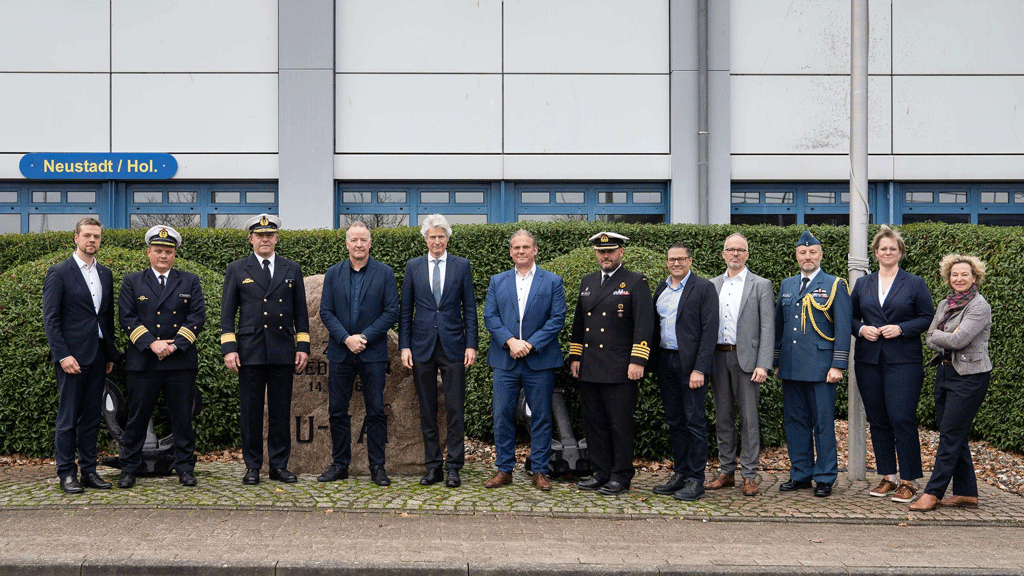
On December 18, 2025, the Commander of the 1st Flotilla, Rear Admiral Christian Walter Meyer, received a delegation from the Canadian government in Eckernförde. This was followed by a visit to ThyssenKrupp Marine Systems (TKMS). The delegation also gained insights into the submarine manufacturing process and subsequently signed a Memorandum of Understanding (MoU).
German and Canadian relations are characterized by a special continuity: For almost 75 years, both nations have functioned as dependable partners, bound by shared values, responsible conduct, and a consistent focus on the future. With the upcoming anniversary year of 2026 in mind, Germany reaffirms its commitment to further intensifying this friendship on economic, cultural, and especially military levels.
Deepening maritime cooperation
The delegation from the Canadian Ministry of National Defence, comprised of representatives from politics, the military, and business, first visited the submarine training center in Eckernförde. This was followed by a tour of the TKMS Marine Systems Shipyard in Kiel, where a Memorandum of Understanding was signed with TKMS and Canadian company Marmen.
Military cooperation between the two countries in the naval field has a long tradition. One example of this close integration is the training of Canadian officers in Eckernförde, which will be further intensified from January 2026. Canada is currently planning a significant expansion of its submarine fleet. Instead of the current four, up to twelve submarines are to sail under the Canadian flag in the future. Germany has officially invited Canada to join the existing German and Norwegian submarine cooperation. A corresponding offer was made by TKMS will be handed over to the Canadian government at the end of January 2026.
“Canada possesses a highly professional navy. There have been numerous opportunities for cooperation, which have been very beneficial to all. We are in a situation where we are fulfilling our deterrence mission in a shared operational area. It can only be advantageous if we do so with the same submarines, using the same tactics and procedures, based on joint training, with the same understanding, and supported by the same technical and logistical resources. I would therefore be pleased if we could also move closer together with Canada on matters of submarine cooperation,” said Rear Admiral Christian Walter Meyer, Commander of the 1st Flotilla.
A fleet of superlatives
- Should Canada decide to procure U212 CD class submarines. If this were to happen, it would mark the birth of a strategic alliance between Germany, Norway, and Canada, setting new technological and operational standards. The project pursues three core objectives:
Global technological leadership: The combination of six German, six Norwegian, and twelve Canadian units would create the world’s largest jointly operating fleet of conventionally powered submarines - Scalability and efficiency: Trilateral defense cooperation would generate enormous economic benefits over decades through synergies in maintenance, logistics and further development.
- Strengthening NATO cohesion. The project ensures the unity of the defense industry within the alliance in a strategically critical segment.
The fact that the significance of this project extends far beyond purely military aspects is underscored by the participation of Canadian Defense Minister Stephen Fuhr at Kiel. The signing of the Memorandum of Understanding, in the presence of Parliamentary State Secretary Nils Schmid at the Federal Ministry of Defence, underscores that the planned submarine cooperation is conceived as a comprehensive technological development partnership. Guided by the motto “Partnership beyond a platform,” the partnership aims to unlock far-reaching economic potential and sustainably strengthen the industrial base of both countries. In a changing world, Germany and Canada are demonstrating impressively that we have far more in common than what divides us.
